Precise and fast model prediction with machine learning - NETRIUM
Project Description
The KATRIN experiment is designed to measure the neutrino mass with a sensitivity of 0.2 eV at the 90% confidence level. To this end, it performs a high-precision measurement of the tritium beta-decay spectrum near the endpoint, where the neutrino mass manifests as a spectral distortion. To infer the neutrino mass from the data, a precise model of the spectrum is required. Moreover, to simultaneously analyze multiple data sets with both correlated and uncorrelated systematic uncertainties, the model prediction must be very fast. However, the numerical calculation used for the first two KATRIN data releases is not sufficient to meet this requirement.
To speed up this process, we developed a machine‑learning model capable of predicting the full tritium spectrum as a function of relevant physical parameters with extremely high precision and drastically reduced runtime within the NETRIUM project. The key to achieving the required performance was to allow the neural network to learn the full spectral shape dependency on the relevant input parameters, or, more precisely, the spectral changes relative to the mean spectrum. To this end, we use the physical parameter values, such as the neutrino mass squared or the magnetic field settings, as input, and the (relative) rate of the full KATRIN spectrum at all data points as output. Our neural network reproduces spectral predictions at 10⁻⁴ accuracy while accelerating computations by at least 3 orders of magnitude.
Results
- Developed a complete neural‑network model for predicting the KATRIN tritium beta‑decay spectrum.
- Achieved per‑mill‑level accuracy (~10⁻⁴), sufficient for neutrino‑mass sensitivity requirements.
- Reduced computation time by at least three orders of magnitude compared to previous analytical methods.
- Enabled full spectral‑shape learning by providing physical parameters as inputs and full relative rate predictions as outputs.
- Established the method as a new standard for upcoming KATRIN analyses, including searches beyond the Standard Model.
- Initiated active collaboration among physics and computer‑science groups to extend ML techniques to other high‑precision experiments.
Follow-up
This method represents a major breakthrough in KATRIN data analysis. It will be applied to all forthcoming neutrino mass analyses and searches for physics beyond the Standard Model using KATRIN data. Furthermore, the success of NETRIUM helped initiate a broader theoretical study of high-precision machine learning-based modeling and exploration of the applicability of these methods to other high-precision physics experiments.
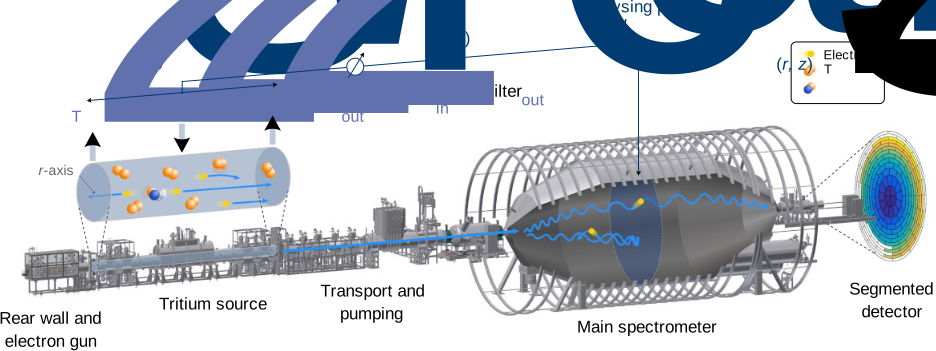
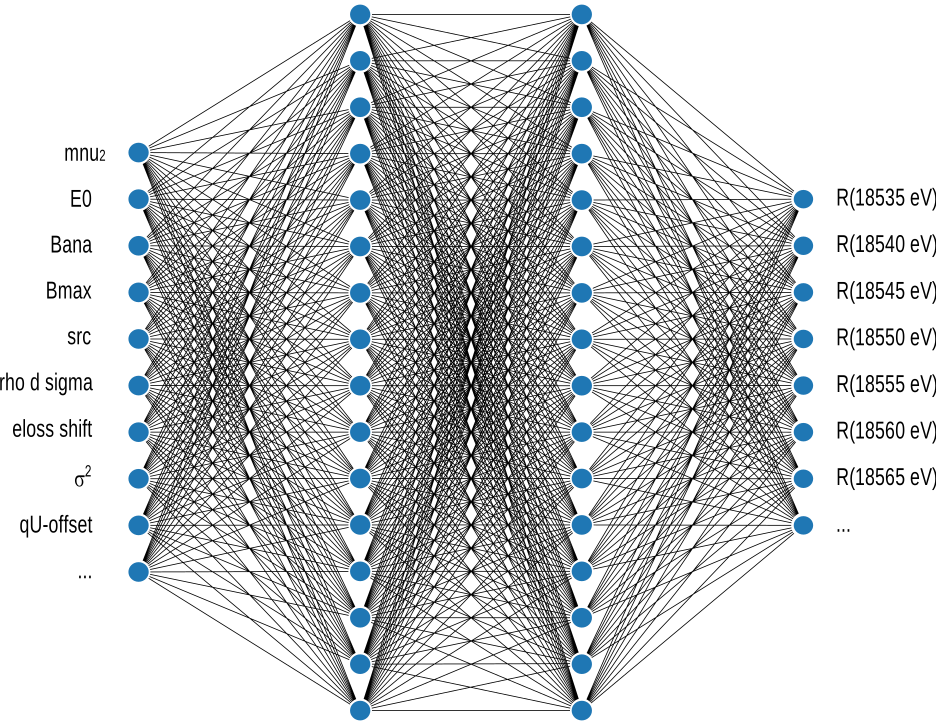
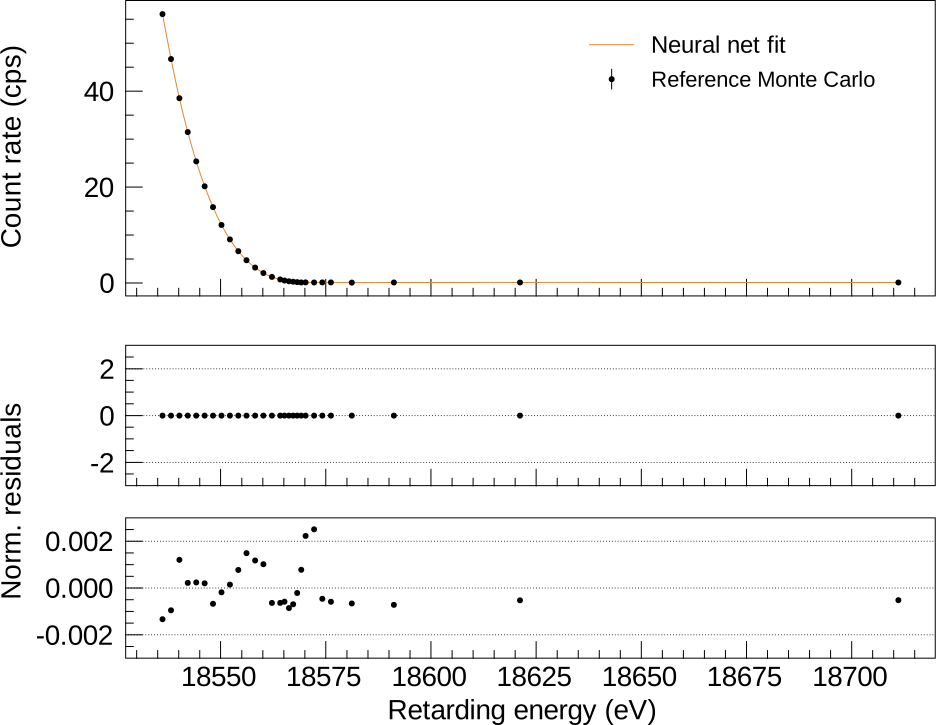
Top: Schematic of the KATRIN experiment. Left: Structure of our neural network: an input layer with one node for each parameter, two fully-connected hidden layers with 128 nodes (amount reduced for visualization), and an output layer with one node for each point in the spectrum. Right: The generated Monte Carlo spectrum (black points) together with the best fit using the neural network (orange line), together with the normalized residuals, once with a regular scale and once with a zoom-in highlighting the underlying structure.
Karl, C., Eller, P. & Mertens, S. Fast and precise model calculation for KATRIN using a neural network. Eur. Phys. J. C 82, 439 (2022). https://doi.org/10.1140/epjc/s10052-022-10384-z
M Aker et al 2022 J. Phys. G: Nucl. Part. Phys. 49 100501. https://doi.org/10.1088/1361-6471/ac834e
KATRIN Collaboration. Measurement of the electric potential and the magnetic field in the shifted analysing plane of the KATRIN experiment. Eur. Phys. J. C 84, 1258 (2024). https://doi.org/10.1140/epjc/s10052-024-13596-7
KATRIN Collaboration et al., Direct neutrino-mass measurement based on 259 days of KATRIN data. Science 388, 180-185 (2025). https://doi.org/10.1126/science.adq9592
The KATRIN Collaboration. Sterile-neutrino search based on 259 days of KATRIN data. Nature 648, 70–75 (2025). https://doi.org/10.1038/s41586-025-09739-9