
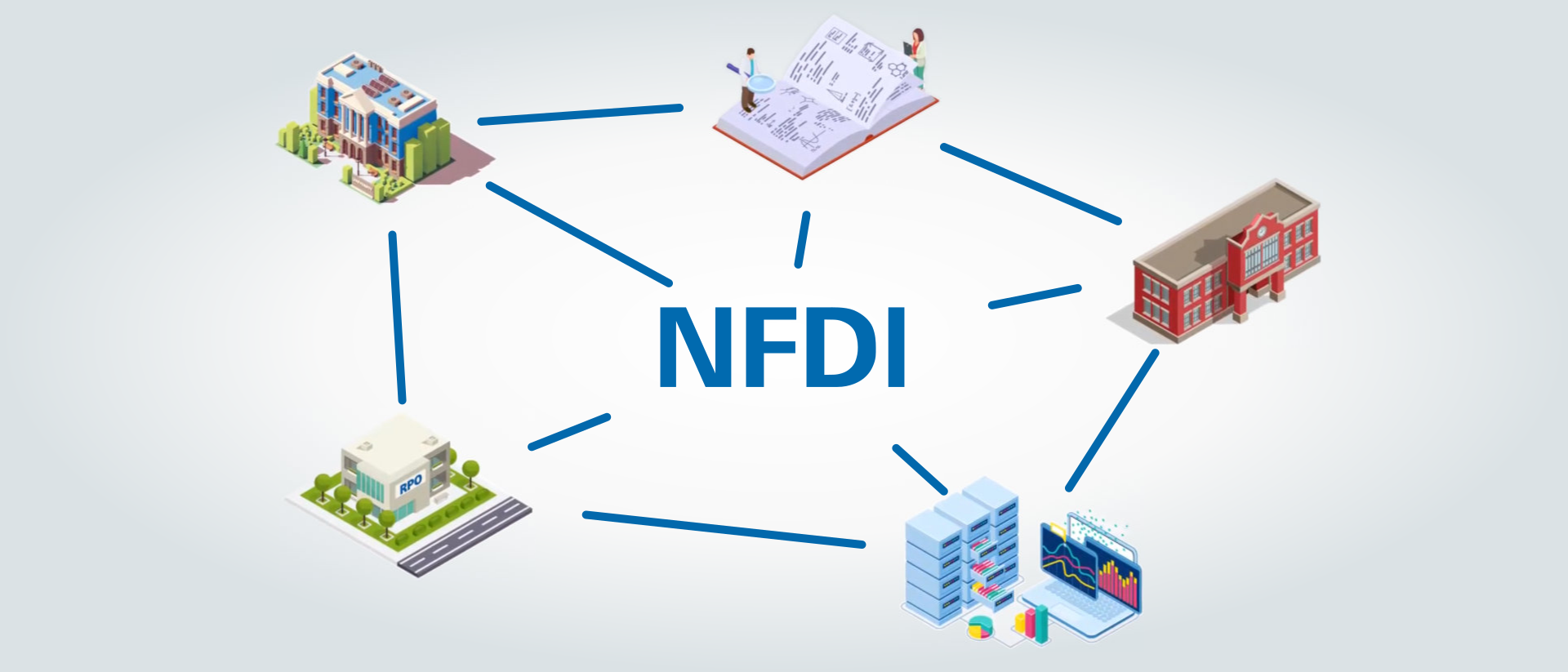
National Research Data Infrastructure
The National Research Data Infrastructure (NFDI) emerges as a network of consortia in order to systematically develop and secure data sets as well as making them accessible in science. The consortia gather data in a science-driven process according to the FAIR-principles (Findable, Accessible, Interoperable, Re-Usable) and provide these for the research community. Various topics get sponsored by the federal and state governments in three selections rounds of the German Research Foundation (DFG). For more information, please visit the website of the DFG or the website of the NFDI association.

BERD@NFDI is a research data infrastructure dedicated to transforming the way Business, Economic, and Related Data are managed. With a special focus on unstructured data, such as images, videos, audio, and text files, we provide a comprehensive suite of services and tools. These tools facilitate the searching, collecting, indexing, processing, analyzing, and preserving both data and algorithms, simplifying your data management needs throughout the entire research process.
Contributors of TUM: Dr. Felicitas Sommer

Data from Photon and Neutron Experiments (DAPHNE4NFDI) focuses on research with photons and neutrons at large-scale research facilities. The properties of photons and neutrons allow us to find out where atoms are and how they move - in materials, new materials, thin films, even at very low temperatures or high pressures. This makes it possible to see the tiniest cracks and pores in a turbine blade, find tiny impurities in a semiconductor, determine the position of individual atoms in a protein molecule, and much more.
Contributors of TUM: Dr. Wiebke Lohstroh (Co-Spokesperson)

DataPLANT - Towards democratization of plant research is a consortium from the heart of the German plant research community. It aims to establish sustainable Research Data Management (RDM) by providing digital (e.g., in the form of software or teaching material) and personal (e.g., via on-site consultation or workshops) assistance.
Contributors of TUM: Prof. Klaus Mayer

FAIR Data Infrastructure for Agrosystems (FAIRagro) is a community-driven initiative that is building a FAIR data infrastructure for agrosystems research. Its goal is to connect existing repositories to make research data FAIR to support sustainable crop production and agroecosystems.
Contributors of TUM: Prof. Dr. Senthold Asseng (Co-Spokesperson)

FAIR Data Infrastructure for Condensed-Matter Physics and the Chemical Physics of Solids (FAIRmat) provides a federated FAIR data infrastructure for materials science and equips researchers with the tools and skills needed for effective research data management. It aims to enable collaborative, reproducible, and legally compliant research by supporting the adoption of FAIR-aligned standards and practices across the scientific community.
Contributors of TUM: Prof. Hans-Joachim Bungartz (Co-Spokesperson)

The German Human Genome-Phenome Archive (GHGA) enables the use of human omics data in research, while ensuring data security and preventing misuse, as a secure national omics data infrastructure. By bridging the gap between research and healthcare, it drives the development of new therapies and diagnostics.
Contributors of TUM: Prof. Julien Gagneur (Co-Spokesperson), Prof. Thomas Meitinger, Prof. Juliane Winkelmann

Mathematical Research Data Initiative (MaRDI) builds a FAIR, interoperable research data infrastructure for the mathematical sciences. By developing standards, certified workflows and supporting services, it enables reproducible research, collaboration and knowledge exchange within mathematics and across related disciplines. Its vision is a community that fully adopts FAIR data practices.
Contributors of TUM: Prof. Mathias Drton (Co-Spokesperson)

NFDI for Catalysis-Related Sciences (NFDI4Cat) is a consortium that creates a national digital infrastructure for catalysis research. Its mission is to establish standardized and FAIR principles for handling research data, fostering digital research workflows, and connecting the scientific community across academia and industry.
Contributors of TUM: Prof. Johannes Lercher (Co-Spokesperson)

NFDI Consortium Earth System Sciences (NFDI4Earth) addresses the digital needs in research data management for the Earth System Sciences. Its scientists cooperate in international and interdisciplinary networks with the overarching aim to understand the functioning and interactions within the Earth system and address the multiple challenges of global change.
Contributors of TUM: Prof. Martin Werner

National Research Data Infrastructure for Immunology (NFDI4Immuno) supports the immunology community by providing a secure, FAIR-compliant platform for sharing, viewing and analyzing immunological data. It offers standards, analytical tools and training to enable reproducible and collaborative research, with the long-term vision of allowing results from different laboratories to be easily accessed, compared and integrated.
Contributors of TUM: Prof. Dr. Dietmar Zehn

National Research Data Infrastructure for Engineering Sciences (NFDI4ING) brings together the engineering community to promote FAIR research data practices and sustainable data management. It develops and standardizes methods and services that make engineering data FAIR, supported by a growing network of researchers and infrastructure partners.
Contributors of TUM: Apl. Prof. Christian Stemmer (Co-Spokesperson)

NFDI4Microbiota is a consortium that focuses on managing, standardizing, and sharing microbiological and microbiome-related research data. It aims to make data FAIR for researchers working with microbiota across various domains, including health, agriculture, and the environment.
Contributors of TUM: Dr. Ilias Lagkouvardos, Prof. Michael Schloter

National Research Data Infrastructure for and with Computer Science (NFDIxCS) aims to develop services for storing complex, domain-specific data objects across the diverse subfields of computer science and to implement FAIR principles throughout. This includes creating reusable data objects that bundle data, metadata, software, and the relevant contextual and execution information in a standardized form.
Contributors of TUM: Prof. Tobias Nipkow, Prof. Dr. Martin Schulz

Patricles, Universe, NuClei and Hadrons for the NFDI (PUNCH4NFDI) is a consortium of particle, astro-, astroparticle, hadron and nuclear physics, representing about 9.000 scientists with a Ph.D. in Germany, from universities, the Max Planck society, the Leibniz Association, and the Helmholtz Association. PUNCH physics addresses the fundamental constituents of matter and their interactions, as well as their role for the development of the largest structures in the universe - stars and galaxies.
Contributors of TUM: Dr. Philipp Eller