
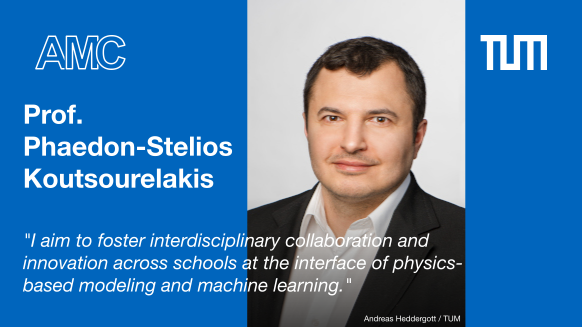
The Atomistic Modeling Center (AMC) has appointed Phaedon-Stelios Koutsourelakis as a new core member. He is Professor of Continuum Mechanics and heads the group of “Data-driven Materials Modeling” at the TUM School of Engineering and Design. With his expertise in multiscale modeling and stochastic analysis, he brings fresh perspectives to AMC's interdisciplinary team.
Physics-integrated generative modeling is a cutting-edge topic. “I envision AMC at the forefront of developing generative, data-efficient frameworks that integrate physics-based principles directly into learning algorithms. Embedding atomistic force fields within machine-learning models will enable predictive, interpretable simulations that accelerate materials discovery,” Koutsourelakis emphasizes the goal of leading in this field.
Highlighting the strength of AMC’s interdisciplinary community, Koutsourelakis adds: “I see significant opportunities for AMC to bridge quantum-mechanical simulation methods, advanced atomistic modeling, and inverse materials-design workflows. By integrating these complementary approaches, we can drive the discovery of novel materials, deepen our understanding of their governing mechanisms, and contribute to AMC’s mission of applying data-driven and statistical methods across disciplinary boundaries.”
Koutsourelakis’ research focuses on computational strategies for modeling and analyzing physical and engineered systems, with a particular emphasis on continuum mechanics and uncertainty quantification. He brings a cyber-enabled statistical discovery mindset to the AMC and aims to foster interdisciplinary collaboration and innovation across schools at the interface of physics-based modeling and machine learning. Besides the above-mentioned topics, a key focus of his contribution lies in bridging scales from atomistic to continuum through probabilistic coarse-graining and Bayesian inference. Koutsourelakis will be bridging atomistic and continuum scales through probabilistic coarse-grained representations that preserve physical interpretability while quantifying uncertainty, enabling reliable, multiscale predictions across complex materials systems.