

Coordinated Programs
The coordinated programs of the German Research Foundation (DFG) include Clusters of Excellence, Collaborative Research Centers, and Transregios. Several of these programs at TUM are associated with the MDSI in order to benefit from our expertise in all data-related aspects of research. A particular focus exists on the common challenges in the field of research data management.

EXC2089: e-conversion focuses on researching energy conversion processes that take place at interfaces. Wherever light, charges, and matter interact, researchers in the Cluster of Excellence investigate the microscopic processes at material interfaces that underpin future energy technologies, advancing the foundations of improved solar power, catalysis, and batteries.
EXC2094: From the Origin of the Universe to the First Building Blocks of Life (ORIGINS) investigates the origin of the Universe and life. The interdisciplinary research network emerges from the very fruitful collaboration between astro-, particle- and nuclear physicists within the previous Excellence Cluster Universe, which explored fundamental properties of the Universe.

EXC2111: Munich Center for Quantum Science and Technology (MCQST) is a world-leading, interdisciplinary research center for Quantum Science and Technology (QST) in Munich. This Cluster of Excellence combines research across fields like physics, mathematics, computer science, electrical engineering, material science, and chemistry.

EXC2145: Munich Cluster for Systems Neurology (SyNergy) investigates how complex neurological diseases such as Alzheimer's disease, stroke, and multiple sclerosis develop. Even though these diseases differ in their clinical manifestations, overlapping mechanisms are involved in their development. For example, the immune system gets activated in dementia, while brain inflammation can cause nerve cells and their supporting glial cells to degenerate.

EXC3092: Biosystems Design Munich (BioSysteM) is a joint undertaking between LMU and TUM. It seeks to design biological systems using engineering principles – and thus create new insights into the fundamental principles of life and pathways to innovative practical applications.

EXC3113: Cluster for Nucleic Acid Sciences and Technologies (NUCLEATE) brings LMU, TUM, and JMU together to unite leading researchers in RNA biology, gene regulation, structural and chemical biology, bioengineering, and translational medicine. The Cluster of Excellence's mission is to advance the full spectrum of nucleic acid research – from fundamental mechanisms to next-generation RNA-based therapeutics.
EXC3137: Munich Center for Transformative Technologies and Societal Change (TransforM) advances social science for highly technologized societies to better understand and shape the transformative power of technology. Its goal is to better understand why, when, and how technologies become socially transformative, and to critically assess and inform transformation pathways ‘all the way through’ – from the early stages of their emergence to their wider socio-economic impact.
SFB1258: Neutrinos and Dark Matter in Astro- and Particle Physics investigates how the weak interaction shapes the universe through neutrinos and dark matter. The CRC explores their roles in cosmic structure, the early universe, and energetic astrophysical events, organized across three areas: Neutrinos, Dark Matter, and Messengers.

SFB1320: Everyday Activity Science and Engineering (EASE) is an interdisciplinary research center at the University of Bremen that investigates everyday activity science and engineering. Its core purpose is to advance our understanding of how human-scale manipulation tasks can be mastered by robotic agents. To achieve this, EASE establishes the research area “Everyday Activity Science and Engineering” and creates a research community that conducts open research, open training, open data, and knowledge sharing.
SFB1371: Microbiome Signatures is focused on clarifying the functional relevance of microbiome signatures and determining their disease-specific contributions. Clinical endpoints with well-established microbiome alterations are being examined, and key mechanisms involving dysregulated immune responses and tissue adaptation processes, such as inflammation and cancer, are being uncovered.

SFB824: Imaging for Selection, Monitoring and Individualisation of Cancer Therapies represented an interdisciplinary consortium which aimed at the development of novel imaging technologies for the selection and monitoring of cancer therapy as important support for personalized medicine.

SFB924: Molecular Mechanisms Regulating Yield and Yield Stability in Plants was a multidisciplinary consortium that studied the molecular basis of plant yield and yield stability. By integrating expertise across reproduction biology, hormone signalling, stress responses, phytopathology and breeding with advanced post-genomic tools, the CRC aimed to identify mechanisms transferable between plant species and support knowledge-based breeding.

SFB1054: Control and Plasticity of Cell-Fate Decisions in the Immune System studied how immune cells, especially T cells, made and adapted their cell-fate decisions. Using advanced single-cell profiling, it investigated both developmental lineage choices and the flexible, reversible responses of mature cells during infection or disease. The goal was to reveal the signals that governed immune plasticity and to inform future targeted immunotherapies.

SFB1321: Modelling and Targeting Pancreatic Cancer investigated the biology of pancreatic ductal adenocarcinoma (PDAC) to develop better therapies for this highly lethal cancer. Combining diverse expertise, it uncovered key molecular mechanisms and created new models and treatment approaches. In the second funding phase, the CRC expanded with advanced genomic and translational tools to identify disease vulnerabilities and accelerate therapeutic innovation.

SFB1335: Aberrant Immune Signals in Cancer investigated how abnormal immune signals contributed to cancer development and progression. Bringing together basic researchers and clinician scientists, the consortium studied key immune-driven mechanisms in blood, gastrointestinal, and skin cancers. Its goal was to uncover corrupted immune pathways that supported malignancy and to enable the development of new therapies that specifically targeted these dysregulated immune signals.

TRR267: Non-coding RNA in the Cardiovascular System aims to advance the understanding of non-coding RNAs in the cardiovascular system and, by addressing key aspects of cardiovascular development, homeostasis, and disease, lay the foundation for novel therapeutic strategies.

TRR274: Checkpoints of Central Nervous System Recovery investigates the multi-cellular, multi-scale and context-dependent mechanisms that shape recovery after CNS injury. By clarifying how neurons, glia and immune cells interact following damage, the consortium aims to improve regenerative strategies and support future clinical translation.

TRR277: Additive Manufacturing in Construction (AMC) advances the digitalisation of construction by rethinking materials, processes and design through innovative 3D printing technologies. The consortium focuses on sustainable, resource- and energy-efficient building methods, supported by the strong research infrastructure and complementary expertise of TU Braunschweig and TU München.

TRR333: Brown and Beige Fat - Organ Crosstalk, Signaling and Energetics (BATenergy) brings together scientists from different fields and focuses on:
- the organ crosstalk between gut, liver, muscle and thermogenic adipose tissues,
- the cell-cell communication within brown and beige fat, and
- the interaction of cell organelles and intracellular signaling pathways in brown/beige adipocytes.

TRR338: Lymphocyte Engineering for Therapeutic Synthetic Immunity (LETSIMMUN) focuses on advancing adoptive T-cell therapy, one of the fastest-growing translational fields in modern medicine. The consortium aims to become a leading hub for cutting-edge basic and translational research in lymphocyte engineering and to develop innovative concepts and engineered cell products that can be translated into clinical use, ultimately providing therapeutic synthetic immunity for patients.

TRR356: PlantMicrobe - Genetic Diversity Shaping Biotic Interactions of Plants studies how genetic diversity influences beneficial and harmful plant–microbe interactions. Bringing together leading groups from LMU Munich, TU Munich and EKU Tübingen, the consortium aims to advance understanding of these relationships and develop new genetic tools to support sustainable plant health.

TRR392: Molecular Evolution in Prebiotic Environments is a multi- and cross-disciplinary network aiming to experimentally demonstrate a cascade of mechanisms creating robust Darwinian evolution and the first sequence information of life from molecules in a prebiotic setting. This collaborative effort brings together several traditionally stand-alone disciplines: astrophysics, biochemistry, biophysics, chemistry, geosciences and theoretical physics as well as several renowned German universities and institutions.
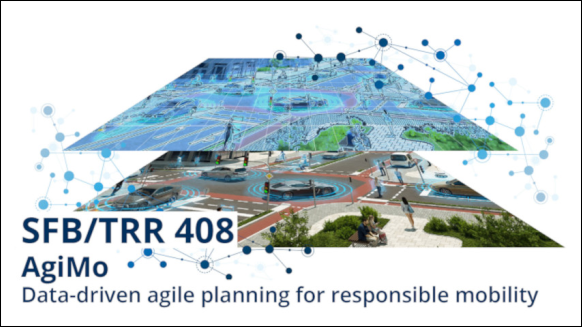
TRR408: Data-driven agile planning for responsible mobility (AgiMo) is an interdisciplinary research programme developing data-driven, agile methods for planning and managing future mobility systems across all transport modes. It integrates responsible mobility criteria based on the “4F” principles (function, form, fairness, forever) and aims to build an open-source digital twin plus participatory planning tools to support evidence-based scenarios.

TRR419: Simulation-based learning in higher education: advancing research on process diagnostics and personalized interventions (SHARP) develops theory on personalised simulation-based learning in higher education, focusing on diagnosing and intervening in professional practice. It studies how personalisation at macro/meso/micro levels (prerequisites, tasks, processes) and tailored scaffolding/feedback affect learning and skills, across multiple disciplines.

TRR89: Invasive Computing was a German research project focused on a new paradigm for parallel computing where programs could dynamically claim and release exclusive access to processor, memory, and communication resources. This "invasive" approach aimed to improve the efficiency and predictability of parallel systems by allowing applications to acquire the resources they needed, when they needed them, and then return them.
TRR109: Discretization in Geometry and Dynamics aimed to pursue research on the discretization of differential geometry and dynamics. In both fields of mathematics, the objects under investigation were usually governed by differential equations. Generally, the term "discretization" referred to any procedure that turned a differential equation into difference equations involving only finitely many variables, whose solutions approximated those of the differential equation.
TRR128: Initiating/Effector Versus Regulatory Mechanisms in Multiple Sclerosis – Progress Towards Tackling the Disease investigated the immune mechanisms that drove and regulated multiple sclerosis (MS), addressing the limited understanding of its molecular causes and treatment responses. Bringing together leading German groups, the consortium combined experimental and clinical research to develop innovative therapeutic strategies.

TRR165: Waves to Weather was a research consortium that investigated the fundamental limits of weather predictability. By combining atmospheric dynamics, cloud physics, and advanced modelling, it aimed to understand why forecasts became uncertain and to develop methods that improved the reliability of weather predictions.

GRK3081: Machine Learning and Control Theory: Exploring Synergies, Complementarities, and Mutual Benefits (METEOR) aims to bridge machine learning and control theory by combining data-driven and model-based approaches. Through interdisciplinary research and training, it prepares a new generation of researchers at the intersection of both fields.