
Learning Spectral Correspondence for Comparative Cortical Mapping
- Sponsored by: TUM Department of Radiology (Klinikum Rechts der Isar) & Imperial College London Department of Computing
- Project lead: Dr. Ricardo Acevedo Cabra
- Scientific lead: Fabian Bongratz, Dr. Lennart Bastian
- TUM co-mentor: TBA
- Term: Summer semester 2026
- Application deadline: Sunday 25.01.2026
Apply to this project here
Background:
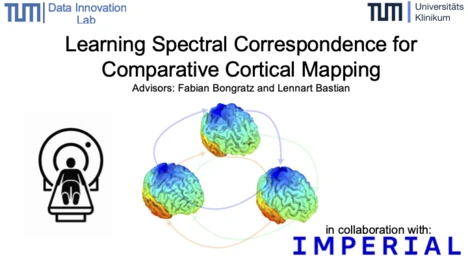
Analysis of brain morphology based on magnetic resonance imaging (MRI) is essential for understanding neurodegenerative diseases like Alzheimer’s disease and monitoring treatment efficacy [7, 8]. Clinical applications require comparison of localized morphological measurements, such as cortical thickness and gyrification, cross-sectionally (between subjects), and longitudinally (for a single subject across time). Such tasks necessitate finding precise point-wise correspondence between brain surfaces from different scans [10]. Despite significant progress in cortical surface reconstruction, establishing precise correspondences across brains remains a unique challenge [3, 4]. Computational diagnostic tools require surface meshes with over 100,000 vertices per brain hemisphere to capture subtle, clinically relevant alterations in the tight and convoluted shape of the cerebral cortex [6]. Although recent developments in geometry processing for a class of spectral methods are promising [9, 1, 2], cortical surface meshes are orders of magnitude larger, making these computationally prohibitive [5].
Goal:
The goal of this project is to investigate and extend a class of spectral methods for shape correspondence to large meshes such as those found in surface-based neuroimaging, enabling their application at the scale of 100,000s of vertices. These methods are inherently unsupervised, offering a precise way to characterize a deformation between a pair of deformed shapes. In the clinical setting, adapting and scaling these methods could enable the effective estimation of spatiotemporal correspondence for downstream medical applications. To summarize, the proposed project aims to:
- Adapt recent advances for spectral shape correspondence from the computer graphics domain to neuroimaging, which includes scaling them to unprecedented input size.
- Establish spatiotemporal correspondence in cortical surfaces for improved early diagnosis of brain disorders.
- Validate the developed methods based on existing large-scale neuroimaging datasets with respect to manual annotations and applicability to Alzheimer’s disease diagnostics.
What we offer:
This project is a joint initiative between research groups from Technical University of Munich and Imperial College London, offering students a unique opportunity to work in an interdisciplinary, research-intensive environment with regular interactions and knowledge exchange with experts from diverse domains. Specifically, students will experience:
- A cutting-edge research project in collaboration with two of Europe’s leading universities
- Close mentorship and guidance by experienced researchers in the field
- Access to high-performance computing resources and curated brain MRI datasets
- Opportunity to publish the findings in a top-tier international conference or journal
What we expect: Good candidates for this project bring an inherent curiosity and at least intermediate programming skills in Python. An interest in applied mathematics is a plus, but a background in the field is not absolutely required; we will tackle topics in graphics processing using tools derived from advanced linear algebra and differential geometry. Familiarity with deep learning frameworks, such as PyTorch, is a plus. Also, remember that this is a team project, which requires effective communication and collaboration on tasks with other team members.
Apply to this project here
References
[1] Lennart Bastian, Alexander Baumann, Emily Hoppe, Vincent B¨ urgin, Ha Young Kim, Mahdi Saleh, Benjamin
Busam, and Nassir Navab. S3m: scalable statistical shape modeling through unsupervised correspondences. In
MICCAI, pages 459–469. Springer, 2023.
[2] Lennart Bastian, Yizheng Xie, Nassir Navab, and Zorah L¨ ahner. Hybrid functional maps for crease-aware
non-isometric shape matching. In CVPR, pages 3313–3323, 2024.
[3] Fabian Bongratz, Jan Fecht, Anne-Marie Rickmann, and Christian Wachinger. V2c-long: Longitudinal cortex
reconstruction with spatiotemporal correspondence. Imaging Neuroscience, 3, 2025.
[4] Fabian Bongratz, Anne-Marie Rickmann, and Christian Wachinger. Neural deformation fields for template-based
reconstruction of cortical surfaces from mri. Medical Image Analysis, 93:103093, April 2024.
[5] V Ehm, N El Amrani, Y Xie, L Bastian, M Gao, W Wang, L Sang, D Cao, T Weißberg, Z L¨ ahner, et al. Beyond
complete shapes: A benchmark for quantitative evaluation of 3d shape surface matching algorithms. In Computer
Graphics Forum, volume 44, page e70186. Wiley Online Library, 2025.
[6] Bruce Fischl. Freesurfer. NeuroImage, 62(2):774–781, 2012.
[7] Gina R. Kuperberg, Matthew R. Broome, Philip K. McGuire, Anthony S. David, Marianna Eddy, Fujiro Ozawa,
Donald Goff, W. Caroline West, Steven C. R. Williams, Andre J. W. van der Kouwe, David H. Salat, Anders M.
Dale, and Bruce Fischl. Regionally localized thinning of the cerebral cortex in schizophrenia. Archives of General
Psychiatry, 60(9):878, September 2003.
[8] Jason P. Lerch, Jens C. Pruessner, Alex Zijdenbos, Harald Hampel, Stefan J. Teipel, and Alan C. Evans. Focal
decline of cortical thickness in alzheimer’s disease identified by computational neuroanatomy. Cerebral Cortex,
15(7):995–1001, November 2004.
[9] Maks Ovsjanikov, Mirela Ben-Chen, Justin Solomon, Adrian Butscher, and Leonidas Guibas. Functional maps: a
flexible representation of maps between shapes. ACM Transactions on Graphics, 31(4):1–11, 2012.
[10] Martin Reuter, Nicholas J Schmansky, H Diana Rosas, and Bruce Fischl. Within-subject template estimation for
unbiased longitudinal image analysis. NeuroImage, 61(4):1402–1418, 2012.