
Counting the Unknown: The Class-Agnostic Low-Shot Challenge
- Sponsored by: inovex GmbH
- Project lead: Dr. Ricardo Acevedo Cabra
- Scientific lead: Dr. Dominik Traxl, Maximilian Vieweg, Kamilla Mohr
- TUM co-mentor: TBA
- Term: Summer semester 2026
- Application deadline: Sunday 25.01.2026
Apply to this project here
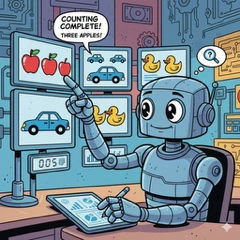
The project focuses on developing a class-agnostic, low-shot, multi-label visual object-counting system. Traditional counting methods depend heavily on class-specific datasets and extensive model fine-tuning, limiting their flexibility in real-world applications. In contrast, this project aims to design a system that can accurately count any object class using only a handful of example clicks, text labels or exemplar images.
Motivation
Object counting is essential across diverse domains such as inventory management, quality control, environmental monitoring, and public safety. A generalized solution that works across object categories without retraining would dramatically improve scalability, adaptability, and practical usability in these fields.
Goals
● Primary Goal: Build a robust, high-accuracy system for class-agnostic, low-shot, multi-label object counting.
● True Multi-Label Capability: Count multiple distinct object classes in an image using only a few examples per class.
● Complex Scene Handling: Maintain high performance in dense, cluttered, or partially occluded scenes.
● Interactive Prototype: Develop a user-friendly interface where non-experts can upload an image, provide 1–5 clicks textual labels or examples, and receive object counts.
Key Milestones
1. SOTA Review & Baseline: Literature review and benchmarking of relevant few-shot and detection-based counting methods.
2. Core Model Development: Integrate module for multi-label inputs, focussing on feature disentanglement for similar classes.
3. Improvement of Reliability: Research and implement techniques to improve robustness across diverse image domains.
4. Evaluation & Refinement: Evaluate model against benchmarks/real-world images and refine it.
5. Build Demonstrator: Develop demonstrator to process user uploads and present the model results.
Requirements for Students
Students should have familiarity with Python and modern machine-learning frameworks (PyTorch, Scikit-Learn, OpenCV, Transformers). Experience with Git, cloud-based development, and REST APIs is beneficial. Curiosity, willingness to experiment with state-of-the-art vision models, and the ability to build clean, user-oriented prototypes are essential.
Apply to this project here