
Build a data-driven engine that automatically uncovers optimization potential in real-world processes
- Sponsored by: Cavalis consulting GmbH
- Project lead: Dr. Ricardo Acevedo Cabra
- Scientific lead: Julius Krug, Moritz Dawert
- TUM co-mentor: TBA
- Term: Summer semester 2026
- Application deadline: Sunday 25.01.2026
Apply to this project here
Motivation:
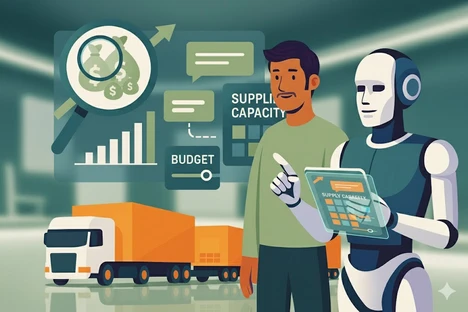
Uncovering value potential within processes is still largely a manual task that requires deep expertise. Even with deep domain knowledge, humans struggle to identify the complex data correlations hidden in daily operations. While intuition guides people, computers can detect patterns, reveal correlations, and evaluate KPIs far more effectively, leaving significant value potential untouched. This challenge becomes especially critical in procurement, where supplier capacities, market conditions, and budget constraints shift faster than teams can react. Manual procurement optimization is no longer sustainable: decisions rely heavily on experience, yet are made in an environment that is too dynamic, too complex, and too data-rich for intuition alone.
That’s why we are building a data-driven procurement engine that continuously improves performance by testing hypotheses, learning from real-world outcomes, and refining procurement decisions over time.
Goal:
The project aims to build a two-sided data-driven procurement solution:
a) Value Potential Finder: identifies improvement areas and quantifies potential value within the procurement process.
b) Optimization Component: Determines optimal procurement decisions within customer-defined constraints (e.g., budget, supplier capacity) and remains robust across different customers and market conditions.
A key focus is external validity—the solution must generalize to unseen procurement data. Students will receive domain guidance but are encouraged to explore their own AI-driven approaches, from rule-based methods to agent-based or simulation models.
Key Milestones:
- Business Understanding: Understand the business behind our problem statement and become celonis literate
- Data Understanding: Understand the data and its model, assess data quality, relevance and structure
- Feature Engineering: Prepare features to train your model
- Modeling: Train a model, iterate with AI techniques to find out what works
- Evaluation: Evaluate your solution and test it for robustness
- Deployment: Deploy your model and compete against a procurement specialist
Requirements:
ML skills in Python; Basic Celonis training, max. 3 hours (Link will be provided by us); Motivation to combine technical and business skills to build a real-world application
Apply to this project here