
Optimizing BESS Trading Strategies Under Perfect Foresight
- Sponsored by: BayWa r.e. Data Services.
- Project lead: Dr. Ricardo Acevedo Cabra
- Scientific lead: Milena Zurmühl
- TUM co-mentor: TBA
- Term: Summer semester 2026
- Application deadline: Sunday 25.01.2026
Apply to this project here
About BayWa r.e.
BayWa r.e. is the home for change makers. We r.e.think energy – how it is produced, stored and can be best used to enable the global renewable energy transition that is essential to the future of our planet. At BayWa r.e. we effect change globally, being a leading global developer, service provider, distributer, and solutions provider. With a focus on wind and solar energy, we have, so far, brought over 6 GW of energy online and manage over 10 GW of assets.
About the Project
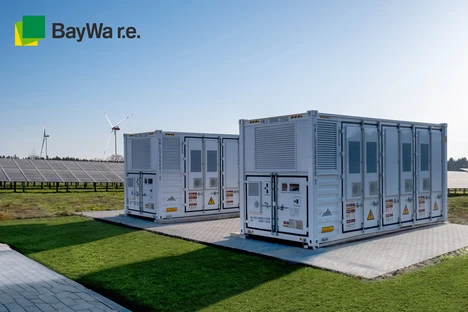
In addition to the expansion of renewable energy technologies such as wind and solar, Battery Energy Storage Systems (BESS) in particular play a key role in the energy transition by providing the flexibility required to balance intermittent renewable generation and fluctuating demand, thus stabilizing the grid. Beyond this, BESS assets create significant economic value through their ability to shift energy across time — storing electricity when it is abundant and inexpensive and releasing it when prices are higher. This capability makes them valuable participants in modern electricity markets, where they can capitalize on intraday price fluctuations and support overall market efficiency. However, the actual profitability of a BESS in energy trading depends heavily on how effectively operators can anticipate and respond to dynamic market signals. In daily operations, trading decisions are hence constrained by forecast uncertainties, as well as operational limitations and market volatility, leading to deviations from theoretically optimal performance.
To quantify this performance gap and identify improvement potential, this project aims to develop an optimization-based benchmark model that determines the maximum achievable daily revenue for a given BESS. The model will thereby have to account for multiple interacting factors, including market prices (e.g., day-ahead or intraday), technical characteristics of a BESS (e.g., capacity, power limits, efficiencies, or state-of-charge (SOC) boundaries), as well as operational limitations (e.g., charging/discharging exclusivity or end-of-day SOC requirements). Additional aspects such as battery degradation costs, multi-market participation, or, in the case of hybrid assets, co-located renewable generation (e.g., PV or wind) may also be incorporated to capture additional real-world complexity. The challenge in this project will be to accurately model all those physical, technical, and operational constraints in a tractable mathematical optimization model, also ensuring scalability for high-resolution data. The respective parametrization of this optimization problem will be based on data from three BESS assets, each providing approximately two years of historical data with a temporal resolution of at least 15 minutes. By relying on historical market and operation data (rather than forecast data as done in real-world trading scenarios), the model will effectively simulate perfect market foresight. This enables the determination of a theoretical optimum, serving as a robust benchmark for evaluating actual trading outcomes, guiding strategy refinement, and supporting data-driven operational improvements to yield the highest economic benefit.
Targeting a cloud-based solution, from a technical perspective, this project provides the great opportunity to engage with the latest state-of-the-art platform technologies, specifically Azure Databricks. This analytics platform was optimized for the Microsoft Azure cloud services and facilitates the seamless integration of data analytics and scalable computing resources, ensuring an efficient processing and analysis of high-resolution, real-time data.
We are looking forward to your application.
Apply to this project here