
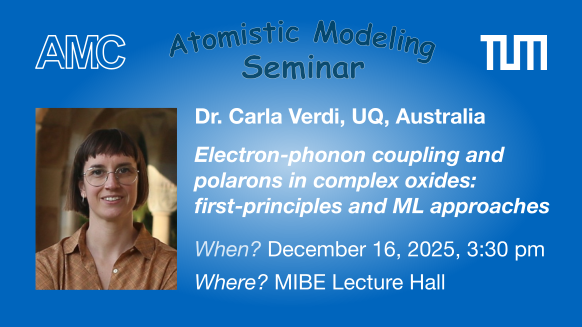
For the last time in 2025, we are happy to welcome an expert in the field of materials science and atomistic modeling!
Dr. Carla Verdi is ARC DECRA Fellow and head of the Computational Quantum Materials Group at the School of Mathematics and Physics at the University of Queensland, Australia. Her research group focuses on first-principles calculations to predict and understand physical properties of materials without relying on empirical models. Verdi and her co-workers use advanced theoretical and computational methods to investigate materials with applications in next-generation optoelectronics and quantum technologies.
In her talk on “Electron-phonon coupling and polarons in complex oxides: first-principles and machine-learning approaches”, Verdi will explore how first-principles and machine-learning methods advance the understanding of electron‑phonon interactions and polaron formation in complex oxides, enabling accurate modeling of anharmonic lattice dynamics, carrier mobilities, and localized charge states. By combining machine‑learned interatomic potentials, transport theory, and automated workflows, these approaches provide new insights into phenomena such as soft‑mode limited transport and defect‑driven polaronic behavior in materials like SrTiO3, KTaO3, and doped TiO2.
Date: Tuesday, December 16, 2025, 3:30 pm
Location: MIBE Lecture Hall
Abstract:
ABO3 perovskite oxides and other transition-metal oxides host a rich interplay between lattice dynamics, charge carriers, and structural distortions, giving rise to phenomena such as quantum paraelectricity, dilute superconductivity, and polaron formation, where charge carriers couple strongly to phonons leading to charge localization and local lattice distortions.
In this talk, I will discuss recent advances in first-principles and machine-learning approaches that enable accurate description of phonon anharmonicity, electron-phonon interactions, and polarons across this broad materials class.
I will first show how machine-learned interatomic potentials, trained on DFT and many-body data, combined with the stochastic self-consistent harmonic approximation, allow accurate characterization of anharmonic lattice dynamics in SrTiO3 and KTaO3. Incorporating these temperature-dependent phonons into the Boltzmann transport equation to predict carrier mobilities highlights the role of soft optical modes and disorder in limiting transport. I will then turn to the modeling of polarons, outlining a first-principles theory that enables systematic calculations of their energies and localization properties, and applying it to investigate electron and hole polarons in these perovskite oxides. Finally, I will discuss a machine-learning accelerated workflow that automates the identification and characterization of polaronic states even in complex defective environments. We demonstrate it for the case of doped TiO2 surfaces, providing new insights into the role of defects and polarons in surface reactivity. Together, these developments provide a powerful framework for modeling and understanding electron-phonon physics in complex materials.